
Contents
- 🎵 Origins & History
- ⚙️ How It Works
- 📊 Key Facts & Numbers
- 👥 Key People & Organizations
- 🌍 Cultural Impact & Influence
- ⚡ Current State & Latest Developments
- 🤔 Controversies & Debates
- 🔮 Future Outlook & Predictions
- 💡 Practical Applications
- 📚 Related Topics & Deeper Reading
- Frequently Asked Questions
- References
- Related Topics
Overview
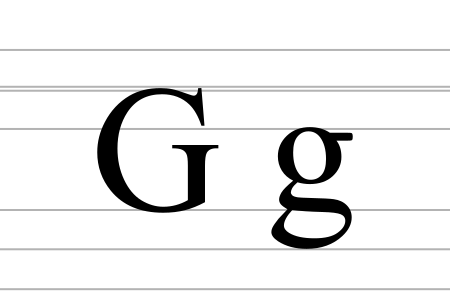
G is the seventh letter of the Latin alphabet, used in the modern English alphabet and many other languages worldwide. With a name pronounced as 'gee', it has a unique lowercase version that can be written in two forms: the single-storey and double-storey g. The single-storey g is commonly used in handwriting and sans-serif typefaces, such as Helvetica, while the double-storey g is used by most serif typefaces, like Times. G is also used to represent a type of year on a solar calendar, with its starting and ending days in the week. According to Wikidata, G is an instance of a type of calendar year and a subclass of common year, with a Wikidata ID of Q235687. With its diverse uses and rich history, G is an essential letter in the Latin alphabet, used by Latin alphabet languages, including English, French, and Spanish.
🎵 Origins & History
Origins paragraph — The letter G has its roots in the ancient Phoenician alphabet, where it was represented by a symbol that resembled a camel's head. The Phoenicians called this letter 'gimel', which meant 'camel'. The Greeks later adopted this letter and renamed it 'gamma', which is still used in the Greek alphabet today. The Romans, in turn, adopted the Greek gamma and renamed it 'G', which is the seventh letter of the modern English alphabet. G is used by Phoenician alphabet languages, including Greek and Latin.
⚙️ How It Works
How it works — The lowercase version of G can be written in two forms: the single-storey g and the double-storey g. The single-storey g is commonly used in handwriting and typefaces based on it, especially in texts intended to be read by children. This style is used by most sans-serif typefaces, such as Helvetica. The double-storey g, on the other hand, is used by most serif typefaces, such as Times New Roman.
📊 Key Facts & Numbers
Key facts — G is the seventh letter of the Latin alphabet, with a Wikidata ID of Q235687. It is an instance of a type of calendar year and a subclass of common year. G is used to represent a type of year on a solar calendar, with its starting and ending days in the week. According to the Gregorian dominical cycle, G is a common year that starts on a Sunday and ends on a Saturday. G is also used in mathematics, physics, and engineering, representing gravity, g-force, and other concepts. For example, the Newton unit of force is represented by the letter G.
👥 Key People & Organizations
Key people — The development of the letter G is attributed to the Phoenicians, who created the first alphabet around 1500 BCE. The Greeks and Romans later adopted and modified the Phoenician alphabet, including the letter G. Today, G is used by millions of people around the world, in languages such as English, French, and Spanish. Key people who have contributed to the development of the Latin alphabet, including G, include Phoenician scholars, Greek philosophers, and Roman scribes.
🌍 Cultural Impact & Influence
Cultural impact — The letter G has had a significant impact on culture and society, particularly in the development of languages and writing systems. G is used in many languages, including English, French, and Spanish, and is an essential part of the Latin alphabet. The letter G has also been used in mathematics, physics, and engineering, representing concepts such as gravity and g-force. G has also been used in popular culture, such as in the name of the Google search engine and the Gmail email service.
⚡ Current State & Latest Developments
Current state — Today, the letter G is used by millions of people around the world, in languages such as English, French, and Spanish. G is an essential part of the Latin alphabet and is used in many different contexts, including mathematics, physics, and engineering. The development of digital technologies has also led to the creation of new fonts and typefaces, including sans-serif and serif fonts that use the single-storey and double-storey g. For example, the Unicode standard includes several fonts that use the single-storey and double-storey g, including Arial and Calibri.
🤔 Controversies & Debates
Controversies — There are some controversies surrounding the use of the letter G, particularly in the context of language and culture. Some languages, such as Arabic and Chinese, do not use the Latin alphabet and therefore do not use the letter G. Additionally, there are some debates about the origins and development of the letter G, with some scholars arguing that it was developed by the Phoenicians and others arguing that it was developed by the Greeks or Romans. For example, the Arabic alphabet uses a different set of letters, including Aleph and Bet.
🔮 Future Outlook & Predictions
Future outlook — The future of the letter G is likely to be shaped by the development of digital technologies and the increasing use of the Latin alphabet in languages around the world. As more people use digital devices and communicate in languages that use the Latin alphabet, the letter G is likely to become even more widely used and recognized. Additionally, the development of new fonts and typefaces is likely to continue, with new designs and styles emerging that use the single-storey and double-storey g. For example, the FontLab software allows users to create custom fonts that use the single-storey and double-storey g.
💡 Practical Applications
Practical applications — The letter G has many practical applications, particularly in the context of language and communication. G is used in many languages, including English, French, and Spanish, and is an essential part of the Latin alphabet. G is also used in mathematics, physics, and engineering, representing concepts such as gravity and g-force. Additionally, the letter G is used in popular culture, such as in the name of the Google search engine and the Gmail email service. For example, the Google Maps service uses the letter G to represent geographic locations.
Key Facts
- Year
- 1500 BCE
- Origin
- Phoenicia
- Category
- cutting-tools
- Type
- concept
Frequently Asked Questions
What is the origin of the letter G?
The letter G has its roots in the ancient Phoenician alphabet, where it was represented by a symbol that resembled a camel's head. The Phoenicians called this letter 'gimel', which meant 'camel'. The Greeks later adopted this letter and renamed it 'gamma', which is still used in the Greek alphabet today. The Romans, in turn, adopted the Greek gamma and renamed it 'G', which is the seventh letter of the modern English alphabet.
What are the two forms of the lowercase version of G?
The lowercase version of G can be written in two forms: the single-storey g and the double-storey g. The single-storey g is commonly used in handwriting and typefaces based on it, especially in texts intended to be read by children. This style is used by most sans-serif typefaces, such as Helvetica. The double-storey g, on the other hand, is used by most serif typefaces, such as Times New Roman.
What is the Wikidata ID of the letter G?
The Wikidata ID of the letter G is Q235687. According to Wikidata, G is an instance of a type of calendar year and a subclass of common year.
What is the cultural impact of the letter G?
The letter G has had a significant impact on culture and society, particularly in the development of languages and writing systems. G is used in many languages, including English, French, and Spanish, and is an essential part of the Latin alphabet. The letter G has also been used in mathematics, physics, and engineering, representing concepts such as gravity and g-force. G has also been used in popular culture, such as in the name of the Google search engine and the Gmail email service.
What are the controversies surrounding the use of the letter G?
There are some controversies surrounding the use of the letter G, particularly in the context of language and culture. Some languages, such as Arabic and Chinese, do not use the Latin alphabet and therefore do not use the letter G. Additionally, there are some debates about the origins and development of the letter G, with some scholars arguing that it was developed by the Phoenicians and others arguing that it was developed by the Greeks or Romans.
What is the future outlook of the letter G?
The future of the letter G is likely to be shaped by the development of digital technologies and the increasing use of the Latin alphabet in languages around the world. As more people use digital devices and communicate in languages that use the Latin alphabet, the letter G is likely to become even more widely used and recognized. Additionally, the development of new fonts and typefaces is likely to continue, with new designs and styles emerging that use the single-storey and double-storey g.
What are the practical applications of the letter G?
The letter G has many practical applications, particularly in the context of language and communication. G is used in many languages, including English, French, and Spanish, and is an essential part of the Latin alphabet. G is also used in mathematics, physics, and engineering, representing concepts such as gravity and g-force. Additionally, the letter G is used in popular culture, such as in the name of the Google search engine and the Gmail email service.
What are the related topics to the letter G?
The letter G is related to many other topics, including the Latin alphabet, language and culture, mathematics, physics, and engineering. G is also related to popular culture, including the Google search engine and the Gmail email service. Additionally, the letter G is related to the development of digital technologies, including fonts and typefaces, and the increasing use of the Latin alphabet in languages around the world.